
Cape Town’s Historic Lighthouses, Privately Guided
The V&A Waterfront:
Navigating the Evolution of Table Bay’s Harbour
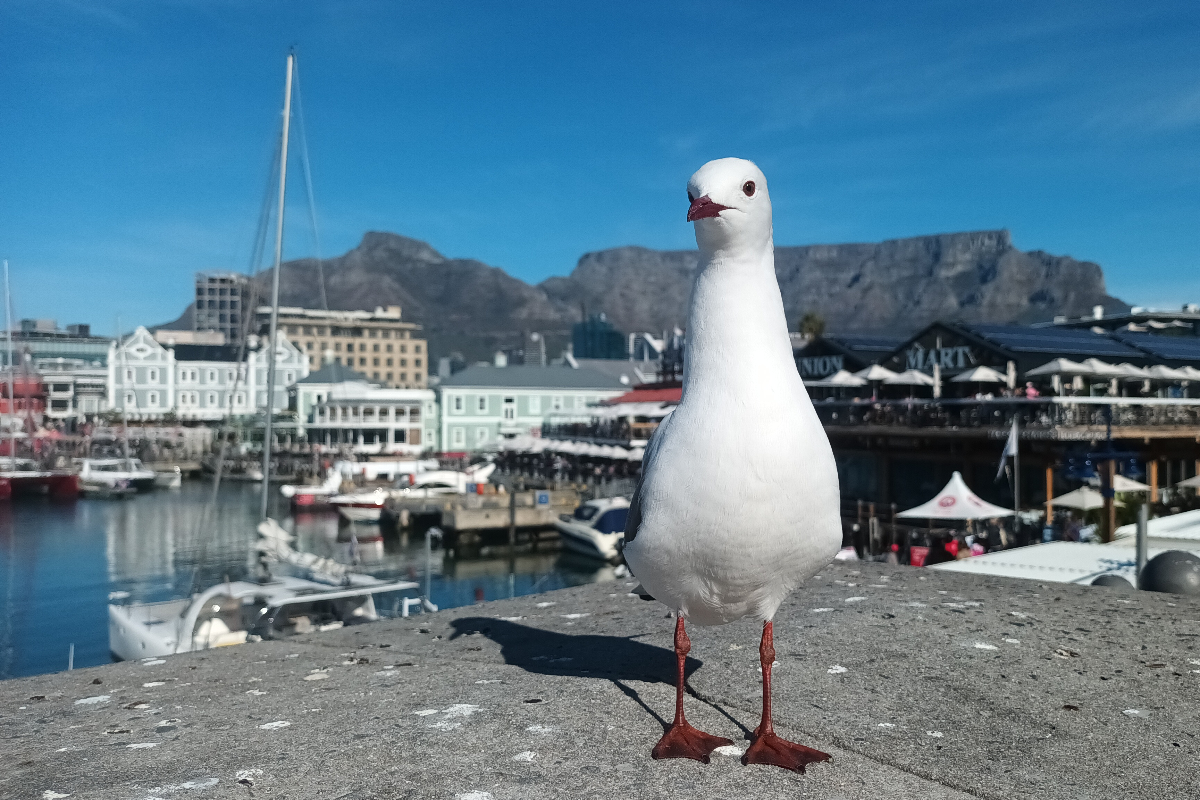
A Seagull at the V&A Waterfront in Cape Town
Join me in discovering the history of the V&A Waterfront (the real hub of Cape Town)’s history.
Today it’s easy to view it as a buzzing playground of shops, restaurants and sunny promenades. But this was once the gritty, hard-working heart of our city’s first port. It was a tough industrial port with its gasworks, coal bunkers, cranes and heavy machinery before it became a tourist attraction. For decades, it was the working harbour that kept Cape Town alive, before the big ships.
Sailors had dreaded the horrors of Table Bay for centuries. We have always been known as the “Cape of Storms”, and it is a title we earned the hard way. Records show about 400 shipwrecks have occurred right here in Table Bay over our known history — vessels smashed against the rocks or dragged under by the sheer ferocity of our winter gales.
Before the V&A was built, there was no safe shelter. Ships had to anchor out in the open bay, helpless against the ferocious north-westerly winter storms. Every passenger and every crate had to be rowed ashore through dangerous, unpredictable surf. It was a massive gamble every single time, and Cape Town paid for it in blood and lost ships.
Some disasters still haunt our maritime stories. In 1722, a terrible gale hit the bay and wrecked multiple vessels, with heavy loss of life. Then came the devastating storm of 1737, when nine ships were wrecked, and over 200 lives were lost in a single night. In 1842, another winter storm drove ships like the Waterloo and Abercrombie Robinson onto the rocks — the sight of the Waterloo breaking up in the surf was one of the darkest moments in our port’s early history. But the final straw came with the Great Gale of 1865. This ferocious storm wrecked around 17 to 19 vessels, including the mail steamer RMS Athens, which was lost with all hands right off Green Point as horrified crowds watched from the shore. These tragedies showed everyone that Cape Town could not carry on without a proper harbour.
By the 1850s, the city had finally had enough. In 1860, young Prince Alfred, Queen Victoria’s son, tipped the first stones into the water to start the breakwater. That long wall (about 1,500 metres) created the Alfred and Victoria Basins. For nearly a hundred years, this became the bustling backbone of Cape Town’s economy — full of the sound of cranes, the smell of coal dust, and the constant movement of cargo and passengers.
As ships grew into massive ocean-going giants in the 20th century, the old harbour could no longer cope. Engineers launched a huge land reclamation project and built the new Duncan Dock further out, which opened in the 1940s. This modern deep-water port took over the heavy shipping. Once Duncan Dock became the main working harbour, the old Victoria & Alfred basins gradually quietened down. That gave us the chance in the late 1980s to redevelop this historic waterfront into the vibrant neighbourhood we enjoy today — still a working harbour, just in a more visitor-friendly way.
Right at the centre of all this history stands the iconic Clock Tower, built in 1883 as the original port captain’s office. Nearby you’ll see the Time Ball Tower. Originally, the time signal dropped from Signal Hill, but in 1894 they moved it here so ships in the harbour could see it clearly. It was restored in the 1990s and still drops on certain days (usually Mondays and Thursdays at 1 pm) as a wonderful living piece of heritage.
The lighthouses of Table Bay have always been our unsung heroes. Green Point Lighthouse has stood guard since 1824 as our first major mainland beacon. Robben Island Lighthouse (completed in 1865) helps from further out, with a special red sector light to warn ships away from dangerous spots like Whale Rock. Closer in, the breakwater was finished and fitted with a powerful light at its end around 1906–1908. This light worked so well that the older Mouille Point lighthouse (built in 1842) became redundant and was later demolished. Years later, in 1960, the Milnerton Lighthouse was built further along the shore to help guide the increased traffic around the expanded port at Duncan Dock.
When you walk from the Clock Tower past the working boats today, you’re walking through the original harbour that built this city. It’s a living testament to how Cape Town adapted: we moved the heavy port work to Duncan Dock so this special corner could become something new without ever losing its seafaring soul.
Next time you’re here, take a breath. Listen for the foghorns and look out toward the horizon. Those beacons are still out there — a constant reminder that this city was built by people who refused to let the ocean win. With strong breakwaters and faithful lights, even the dreaded Cape of Storms finally became a place we could call home.