Cape Town’s Historic Lighthouses, Privately Guided
The Cape as a Cheap Pit Stop:
Institutional Neglect by the VOC
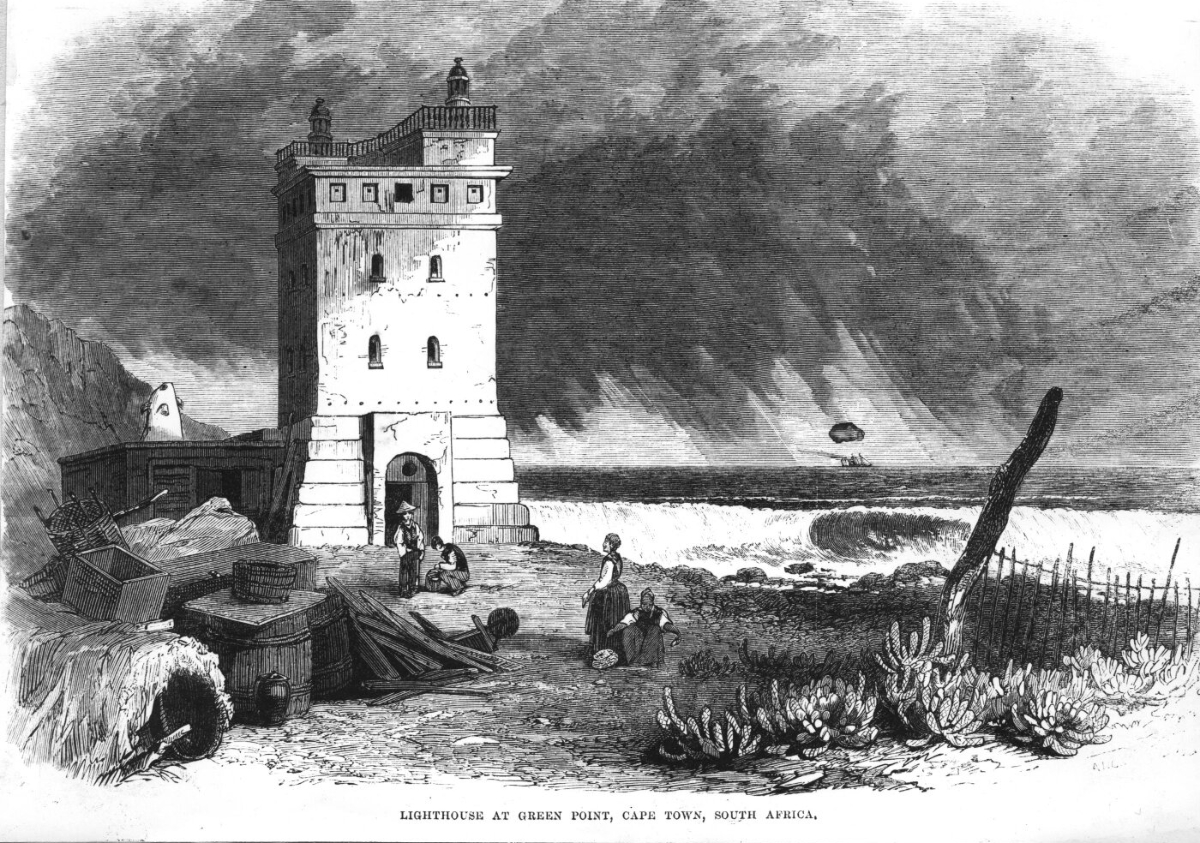
A drawing of the original 1824 lighthouse at Green Point by https://atom.drisa.co.za/index.php/green-point-lighthouse-2
From 1652 to 1795 the Dutch East India Company (VOC) ran the Cape Colony. For nearly a century and a half the place sat in one of the most useful spots on Earth—the halfway house between Europe and the spice riches of the East, the famous “Tavern of the Seas.” You’d think a company that understood maps, ships and money better than almost anyone would have poured resources into making it a proper, solid base. Instead the VOC treated the Cape like a cost centre: keep the ships watered and fed, keep the expenses low, and don’t bother building anything that didn’t directly pad the bottom line.The result was deliberate under-development. No real civic institutions, almost no serious infrastructure, and an education system that stayed stuck at the elementary level. Two comparisons make the point clear: the speed with which New England built universities, and the total absence of lighthouses on one of the world’s most dangerous coastlines—despite the Dutch being world-class lighthouse builders at home.
Company Logic, Not Colony Logic
The VOC was a publicly traded corporation answerable to the Heeren XVII in Amsterdam. Every guilder spent at the Cape was a guilder not returned to shareholders. The English Puritans who landed in Massachusetts wanted to build a lasting society. The VOC just wanted a reliable refreshment station that wouldn’t cost too much or get ideas of its own. So the company kept tight monopolies, fixed prices, restricted manufacturing and limited political freedom. An under-educated, dependent population of free burghers, slaves and subjugated Khoikhoi suited them far better than a confident, self-governing society that might start demanding roads, schools or better harbours.
Books vs Balance Sheets: Education
In Massachusetts the settlers founded Harvard College in 1636—only sixteen years after the Massachusetts Bay Colony got going. They saw higher education as essential for ministers, leaders and a literate public.At the Cape the VOC ruled for 143 years and founded zero universities or proper colleges. Elementary schooling existed—church schools, a few for slave children from the late 1650s, a Latin school in Cape Town in 1714—but nothing approaching tertiary education. Anyone who wanted real higher learning had to ship their children back to the Netherlands, a luxury reserved for the richest officials. South Africa’s first tertiary institution, the South African College (later the University of Cape Town), only appeared in 1829 under British rule—177 years after van Riebeeck landed. The Cape stayed an intellectual backwater by design.
Lights Out on the Cape of Storms
The Dutch knew how to build lighthouses. Back home the Brandaris on Terschelling dates from a beacon in 1323 and a proper tower in 1594. The Vuurbaak at Katwijk aan Zee went up in 1605. By the time the VOC arrived at the Cape, the Republic already had a network of coastal lights and fire beacons protecting its own busy waters. Yet at the Cape—nicknamed the Cape of Storms for good reason—they built nothing permanent. Table Bay and the Agulhas coast regularly wrecked ships and drowned crews. Van Riebeeck did try open wood fires (later pitch rings) on the high point of Robben Island to guide vessels at night. Timber ran out, and the practice stayed makeshift. For the entire Dutch period there were no permanent masonry towers, no proper lenses, no systematic coastal lights. The directors in Amsterdam apparently calculated that the cost of building and staffing real lighthouses outweighed the occasional loss of an Indiaman. Shipwrecks were just a business expense. The first proper lighthouse in South Africa, Green Point, was only lit in 1824 under the British, designed by Herman Schutte.
The Long Shadow
The VOC was an extractive trading company, not a nation-builder. Human capital and public infrastructure looked like liabilities on the ledger, not investments. By starving the Cape of higher education it limited intellectual and political growth. By refusing basic navigational aids it accepted regular disasters as the price of doing business. Massachusetts shows the contrast wasn’t inevitable. Distance and scarce resources didn’t force the stagnation; corporate priorities did. The Cape remained a useful but neglected way-station until a different power decided it was worth developing properly.
Since then till now
Green Point Lighthouse, first lit in 1824, was only the beginning. Within a few decades the dangerous coastline that had claimed so many VOC ships received a proper system of permanent lights. Cape Agulhas (the southernmost tip of Africa) got its lighthouse in 1849 after repeated disasters. Cape Recife followed in 1851, Bird Island in the early 1850s, Cape Point in 1860, Cape St Blaize at Mossel Bay in 1864, and many more through the later nineteenth and twentieth centuries. By the mid-twentieth century South Africa had a full network of manned and later automated lighthouses stretching around the coast. The last major new tower of the period, at Groenriviermond, was completed in 1988. What the VOC had refused to build for 143 years, later governments constructed as a matter of course.
Today you can still step into that history by joining lighthouse keepers’ legacy tours to visit several of these striking coastal sentinels.