
Cape Town’s Historic Lighthouses, Privately Guided
Slangkop Lighthouse:
The Prefabricated Giant from Birmingham
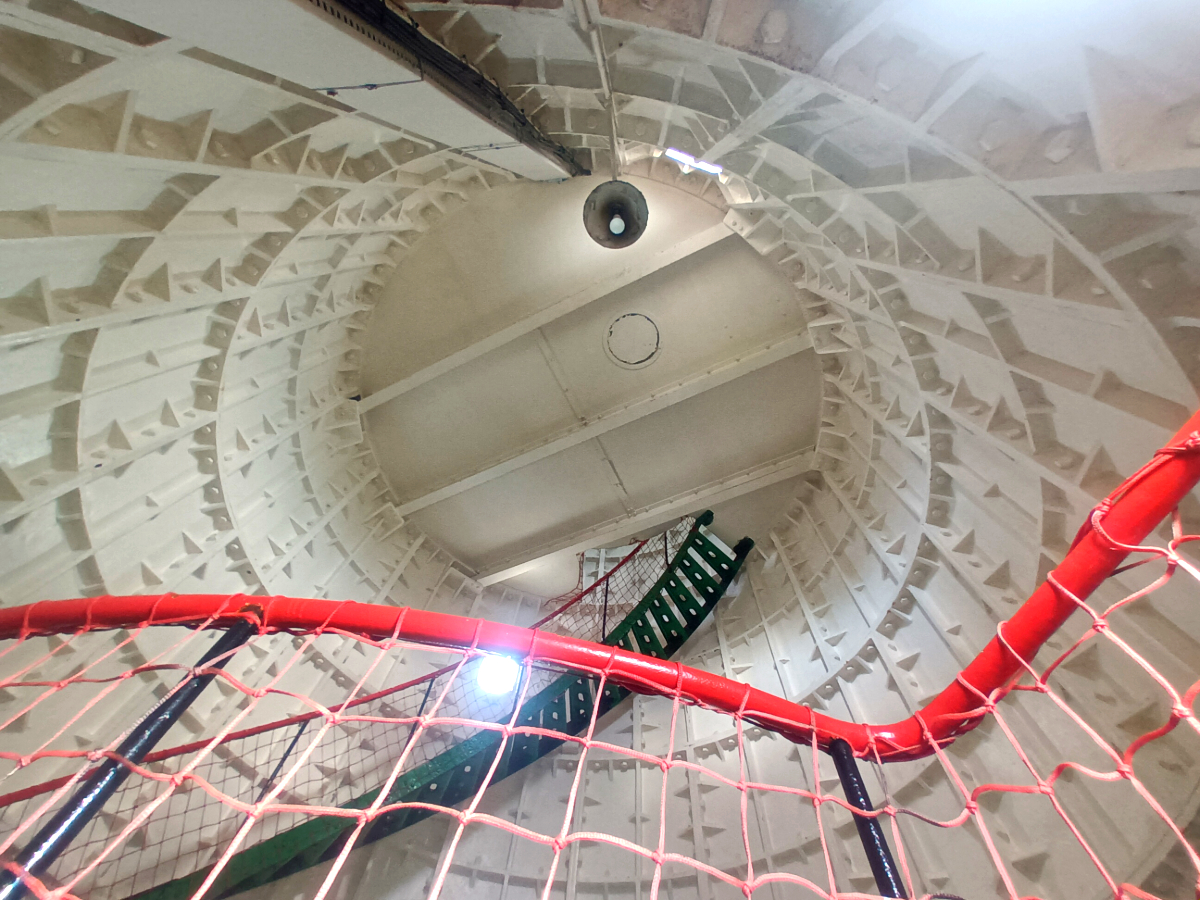
Inside the Slangkop Lighthouse
It is hard to believe that South Africa, a modern global leader in steel production, once had to import a cast-iron lighthouse structure—the tallest of its kind in the country. The truth is, it was not even the first time: the old lighthouse at Cape Point, as well as the Roman Rock Lighthouse, were also imported from England decades earlier.
South Africa’s iron and steel industry was soon to get off the ground between the 1920s and 1930s, but it was not ready yet for the high-precision work required to cast the pieces for a 33-meter-tall lighthouse. Birmingham, situated right by the Black Country where all the necessary coal, iron ore, and limestone came from, was by this time well-equipped with the right industry and specialised skills for the job.
At a specialised British iron foundry, molten iron would be cast into sand moulds to create 272 precision pieces, each of 500 kg, that would make up the walls of the lighthouse. Before leaving England, these interlocking plates were fully fitted together at a trial assembly to ensure every bolt aligned, before being neatly disassembled and packed for an epic maritime voyage.
The massive iron puzzle pieces, along with the internal staircases and structural elements, were loaded onto cargo vessels bound for the Cape of Good Hope. Crossing thousands of miles of open ocean, the journey typically took several weeks aboard steamships of the era.
Once the cargo touched down in Cape Town, the heavy components had to be transported down the rugged Cape Peninsula to Kommetjie. Before the days of reliable coastal highways, hauling tons of cast iron required gruelling overland logistics, most likely using heavy wagons and ox-teams across rough terrain.
On-site at Slangkop Point, construction crews meticulously bolted the towering structure together tier by tier, sealing the joints against the harsh Atlantic elements. Above the heavy iron entrance door, builders proudly cast the date 1914, marking the structural completion of the tower just as the foundation was set.
Yet, despite the date above the door, the beacon within remained dark for half a decade. The reason lay half a world away: the outbreak of the First World War in 1914.
The intricate optical apparatus—the rotating 1st order Fresnel lens and clockwork mechanism needed to project the light across the treacherous waters—had been ordered from European manufacturers, but wartime blockades, manufacturing disruptions, and shipping hazards completely severed the supply chain. Although the records are not clear on it, the vital optical equipment could not be safely delivered and installed until around 1917, or possibly even later.
It was not until 1919 that the lighthouse was officially unveiled and the light started flashing consistently, four flashes every 20 seconds (and since 1936 four flashes every 30 seconds), safely guiding mariners around the wild Atlantic coast at last.