
Cape Town’s Historic Lighthouses, Privately Guided
Polishing the Past:
What a Chamois Taught Me About My Grandfather’s Life as a Lighthouse Keeper
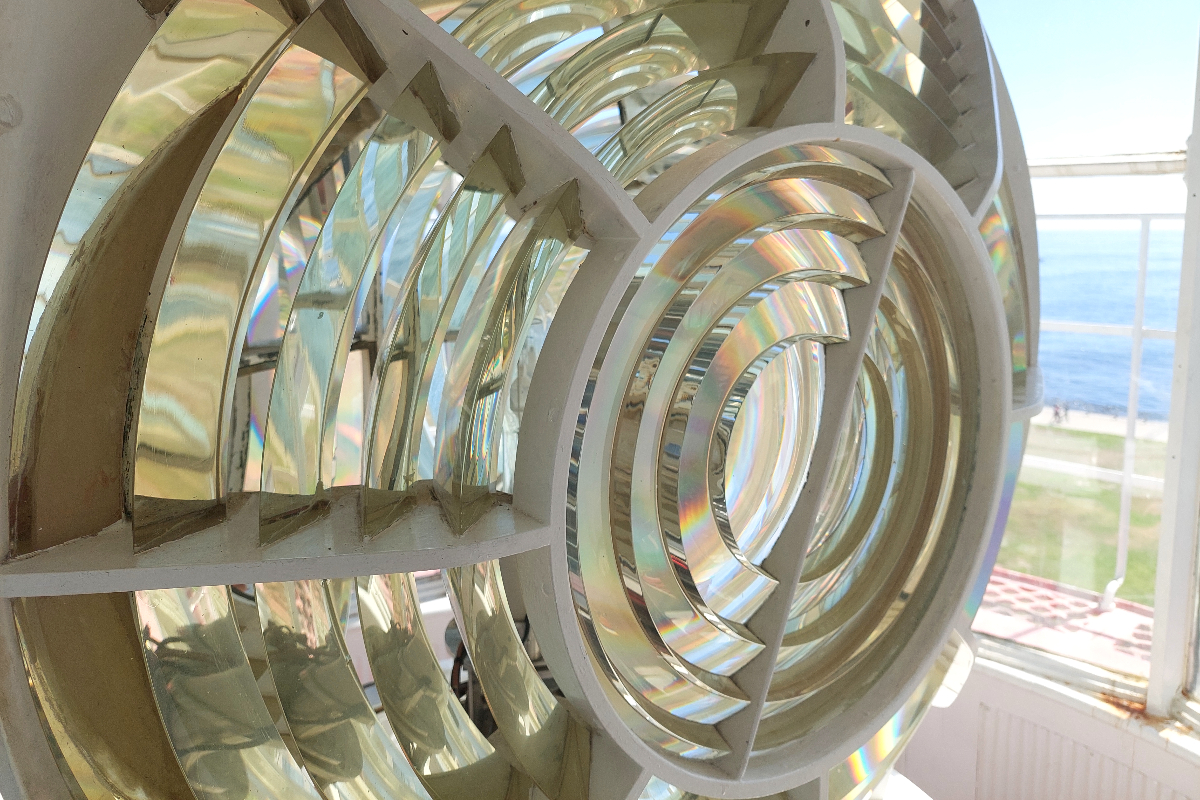
Multi-faceted glass assembly off the Green Point Lighthouse Fresnel lens.
Whenever I wash the car and pick up that little plastic box with the artificial chamois in it—right after the wash and rinse—I think of my grandfather. It immediately takes me back to when I was young, listening to him talk about the quality difference between artificial and real leather Chamois. I can still clearly hear him stating that the new synthetic ones were just as good, maybe even better than the traditional leather ones.
Back then, I couldn’t have been more than eight years old. What stuck with me wasn’t the technical comparison, but the simple fact that there was such a thing as a leather Chamois—animal hide used to clean and dry surfaces—and that it was considered “better” than a normal cloth. It was a strange insight into time and space for a kid, realising that people lived in different eras and were accustomed to technologies so different from the ones I was growing up with.
Later, this memory helped me better understand my grandfather’s life as a lighthouse keeper. The Chamois was part of a keeper’s daily arsenal. People say a lightkeeper spent half his life cleaning and polishing, and it’s easy to see why. When you think about the evolution of lighthouse technology over the last few centuries, you realise how much work went into the basics.
When those immense, brilliant Fresnel lenses became standard in the 19th century, the light source was still primitive—candles or open-flame burners fueled by sperm whale oil, or even sheep-tail fat in some cases here in South Africa. These light sources were incredibly dirty. A Fresnel lens, which could stand nearly 3.6 meters tall and consist of over a thousand individual glass pieces, couldn’t perform if it were covered in soot. Dirty optics meant an ineffective beam, and in the business of saving lives out on the dark ocean, that wasn’t an option. Cleaning wasn’t just a chore; it was the job.
It wasn’t until the 1930s that South African lighthouses really saw the transition to electricity. Before that, the process evolved from simple single-wick oil burners to multi-wick Argand burners, then to petroleum-vapour burners. As the technology improved, the light didn’t just burn brighter; it burned cleaner. That shift must have been a godsend to the keepers of the time—a relief of time and elbow grease that we, in our modern world, are blissfully unaware of.