Cape Town’s Historic Lighthouses, Privately Guided
Robben Island Lighthouse:
From Fire Hill to Flashing Beacon
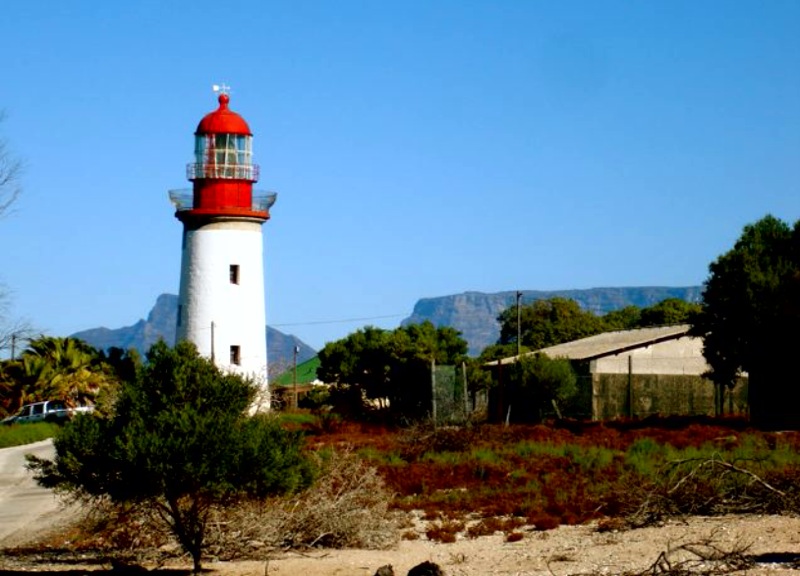
The beam of a lighthouse can reach many nautical miles across the dark ocean
Robben Island rises modestly from the waters of Table Bay, a low-lying outcrop just a short distance from Cape Town. To sailors approaching from the north, it has long been both a landmark and a peril. Seeing table mountain as you approached the low lying land of Robben Island, was a clear sign of reaching your destination after months at sea.
The island is essentially the exposed summit of a submerged mountain, linked to the mainland by an underwater ridge. Its jagged coastline is fringed by reefs and rocks that lurk just beneath the surface, including the notorious Whale Rock, which does not break the water at all. Rough Atlantic swells, sudden gales, dense fog, and strong currents have claimed many vessels over the centuries. This “homecoming” landmark was also the last, and often most dangerous, obstical to be avoided along the whole route.
Historical records document at least two dozen shipwrecks in these waters, with some surveys suggesting far more. The earliest known was a Dutch sealer in 1611. Later losses included the Schapenjacht in 1660, the treasure-laden Dageraad in 1694, and more recent casualties such as the Taiwanese fishing boat Fong Chung II in 1975 and the iron-ore carrier Daeyang Family in 1986. Ships driven onto the rocks were often broken apart swiftly by the relentless surf.
From the earliest days of European settlement at the Cape, the island’s dangers demanded a warning system. In the 1650s, Jan van Riebeeck, the first Dutch commander, ordered large bonfires lit at night on the island’s highest point whenever ships were expected. That hill, rising about 30 metres above the sea, became known as Vuurberg, or Fire Hill. The fires—fuelled at first by wood or coal, and earlier by pitch rings on simple scaffolding—served as South Africa’s first navigational aid. By day, flags flown from a mast provided an additional signal. These rudimentary beacons guided Dutch East India Company vessels safely toward the anchorage while alerting them to the surrounding hazards.The permanent lighthouse that still stands today was completed in 1864 and first lit on the evening of 1 January 1865. Designed by Colonial Engineer John Scott Tucker and built by Joseph Flack, it is an 18-metre cylindrical masonry tower rising from Minto Hill (renamed after a nineteenth-century surgeon-superintendent who served on the island). The structure is painted white with a distinctive black vertical stripe on its eastern face and a red lantern and dome. It is unique among South African lighthouses in using an occulting or flashing light rather than a revolving one: a white beam shines for five seconds, then is eclipsed for two, repeating every seven seconds. The 46,000-candela light is visible for 24 nautical miles. A fixed red sector marks the position of Whale Rock for vessels approaching from certain angles.
Electrified in 1938 and later updated with modern fittings, the lighthouse also received a fog signal—first an explosive device after a 1901 wreck, later a powerful foghorn said at one time to be among the largest in the world.
For generations, dedicated lightkeepers and their families lived on the island to keep the beacon burning. Island stations like Robben Island were among the most isolated and demanding postings in South Africa. In the early years the station was staffed by several keepers; the tower itself was designed with living quarters on the lower floors (kitchen, living room, bedrooms and stores). Supplies arrived only once a month by harbour tug and were frequently delayed by bad weather. Fresh water was scarce, making vegetable gardens difficult, and meat was a rare treat, though the surrounding sea offered abundant crayfish, mussels and fish. Children were usually sent to boarding school on the mainland, returning for holidays filled with sea and sunshine. The isolation could feel intense, especially in the quiet years after the leper colony closed in 1931, when the keeper’s family were among the only permanent residents. During the prison era (1960–1996) the keepers and their families shared the island with warders, depending on Prison Services for water, supplies and transport. Some keepers’ daughters later married young warders. Duties were constant: trimming wicks and topping oil lamps in the pre-electric era, winding clockwork mechanisms, maintaining the fog signal, recording weather in the logbook, and ensuring the light never failed. Today the station is largely automated, but a keeper visits the island to maintain the equipment.
Even after the lighthouse began its steady work, the waters remained treacherous, and wrecks continued. Yet the light has guided countless ships safely into Table Bay for more than a century and a half. Today the automated beacon continues its quiet duty on an island better known for other chapters of its history—prison, hospital, military post—yet still serving its original, life-preserving role as a maritime sentinel.